
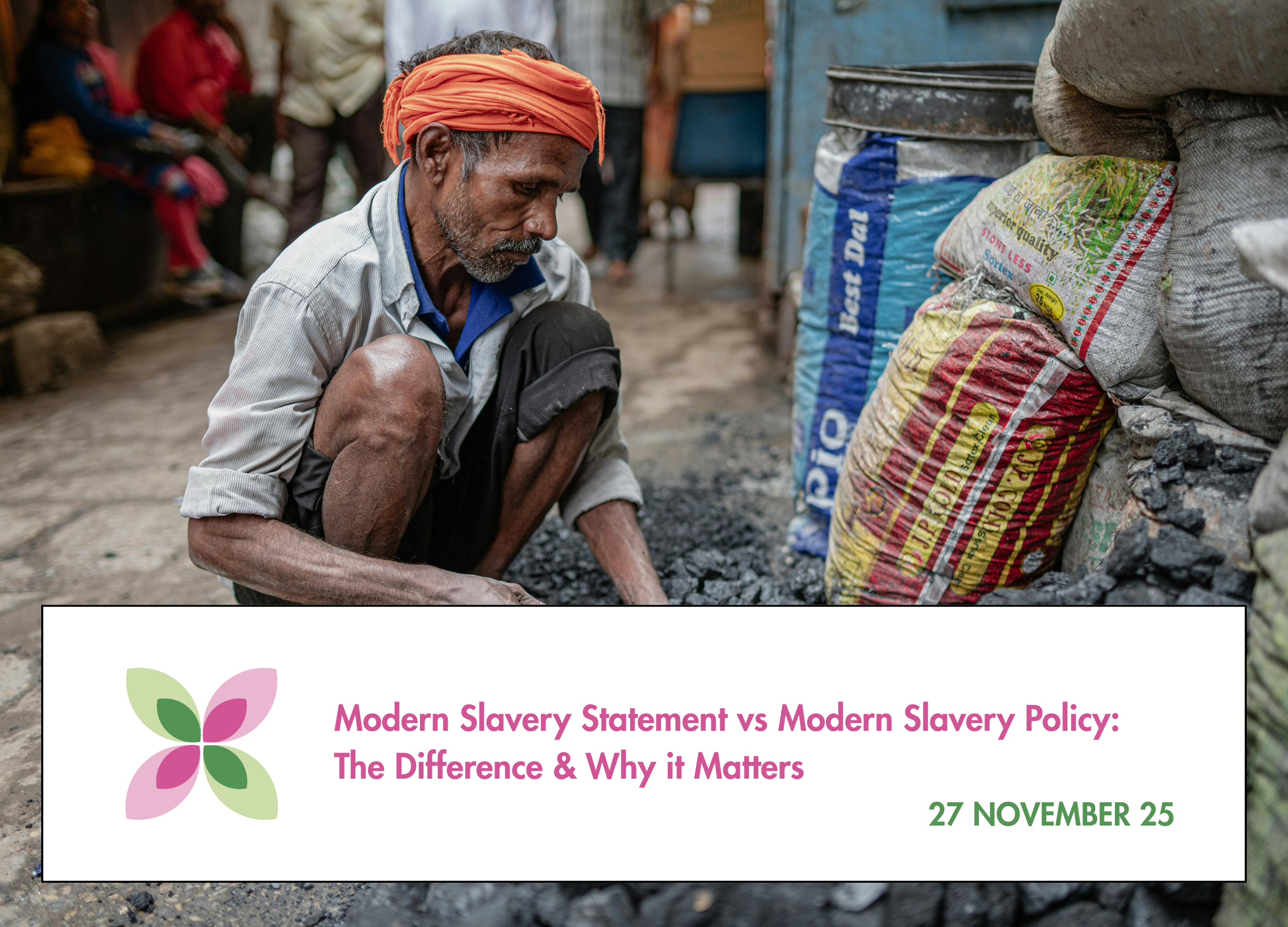
If you’re an architect, designer or specifier conducting due diligence on product suppliers, you want to make sure your suppliers are taking meaningful action to address modern slavery.
This means that understanding the difference between a Modern Slavery Statement and a Modern Slavery Policy is essential.
As someone who works with product manufacturers and retailers, I frequently see questions from architects, designers, construction companies, and specifiers around modern slavery.
One of the most common questions is:
Q: Do you have a Modern Slavery Statement or a Modern Slavery Policy?
These two documents are vastly different and should not be grouped together.
Let’s explore why this distinction matters.
What Is a Modern Slavery Statement?
A Modern Slavery Statement is a public document required under legislation, such as the UK Modern Slavery Act 2015 or the Australian Modern Slavery Act 2018.
It requires companies to identify risks of modern slavery in their supply chains and outline the actions they are taking to address those risks.
In Australia, the legislation requires companies to meet seven mandatory reporting criteria.
The Seven Modern Slavery Mandatory Reporting Requirements (Australia):
Identify the reporting entity – Clearly state the company submitting the statement.
Structure, operations, and supply chains – Provide an overview of business operations and supply chains.
Risks of modern slavery – Identify where modern slavery risks exist in your operations and supply chains.
Actions taken to address risks – Outline steps taken to mitigate modern slavery risks.
Assessing effectiveness – Describe how the company measures the success of its actions.
Consultation process – Detail how the company consulted internally and with owned entities.
Any other relevant information – Include any additional information that adds context.
While the statement must meet these mandatory requirements, not all statements are equal in quality.
Some companies publish detailed, thoughtful statements that show genuine efforts to address risks. Others, however, lack substance and appear to be more of a box-ticking exercise.
What to Watch Out For
If a company’s statement simply claims that it works with “reputable suppliers” and sees “little to no risk” of modern slavery, this is a red flag.
It suggests that they may not have conducted a thorough risk assessment of their supply chain — particularly at the Tier 2 and Tier 3 levels. These deeper tiers often carry the highest risk of modern slavery, especially in industries like textiles, electronics, and construction materials.
For specifiers conducting due diligence, it’s important to:
Read the statement carefully
Look for evidence of real action
Assess whether the company addresses the seven mandatory requirements
Check if the company outlines risk assessment processes and remediation plans
If a company’s statement looks the same year after year with no updates or improvements, this could indicate that their actions are not evolving or that they are treating this as a one-off exercise.
What Is a Modern Slavery Policy?
A Modern Slavery Policy (or, preferably, a Human Rights Policy) is an internal document that outlines a company’s commitment to addressing modern slavery and human rights risks.
A robust Human Rights Policy should:
Go beyond just modern slavery and address broader labour and human rights issues
Include freedom of association, the right to collective bargaining, non-discrimination, and safe working conditions.
Having a policy doesn’t mean a supplier is taking action
Policies are important as they set out the company's intentions and commitments.
However, a policy does not necessarily mean the company is taking action.
I’ve written many Human Rights Policies for clients to meet tender requirements or prequalification standards, but that’s where it ends. Policies often sit in a drawer, never to be actioned.
For this reason, a policy alone should not be considered sufficient evidence of a company’s efforts to address modern slavery.
Key Questions to Ask Suppliers with Policies
If you’re accepting a policy as part of your due diligence process, follow up with the supplier and ask:
Have you conducted a risk assessment of your supply chain?
Have you identified high-risk products, materials, countries, industries, and worker types?
What actions are you taking to address these risks?
How do you evaluate the effectiveness of your actions?
Do you have a remediation process in place?
Why the Difference Between A Statement and a Policy Matters
The distinction between a Modern Slavery Statement and a Modern Slavery Policy is crucial because it highlights whether a company is actually taking meaningful action or simply making promises on paper.
A statement should demonstrate that a company is actively working to:
Identify risks
Take action to address them
Measure the effectiveness of their efforts (Are we having an impact)
Continuously improve year-on-year
A policy, while important, is only a starting point. It should guide the company’s actions but needs to be supported by ongoing risk assessments, supplier engagement, and remediation processes.
The Problem with Box-Ticking
Unfortunately, many companies take a tick-box approach to addressing modern slavery.
They may draft a policy or publish a statement, and then believe their work is done. This approach will not reduce modern slavery or improve the conditions of vulnerable workers in supply chains.
As an industry, we need to demand more.
We need to:
Conduct proper due diligence
Engage with suppliers beyond Tier 1
Continuously improve our systems
Measure the impact of our actions
The only way to eradicate modern slavery is through meaningful action — not just compliance and box ticking.
You have the power to make a real and lasting difference
If you’re conducting due diligence on suppliers, don’t just ask for a policy or a statement. Read the documents. Assess whether the company is identifying risks, taking action, and measuring effectiveness.
Remember: A policy is a promise. A statement should be evidence of action.
The goal should be to partner with companies that are committed to making a real difference in addressing modern slavery risks in their supply chains.
Want to know more about Modern Slavery Statements?
Even if you're not legally required to report under the Modern Slavery Act (Cth), many of your clients are. And increasingly, they expect their suppliers to step up – especially those providing furniture, textiles, fittings, finishes, or design services.