Modern Slavery Statements

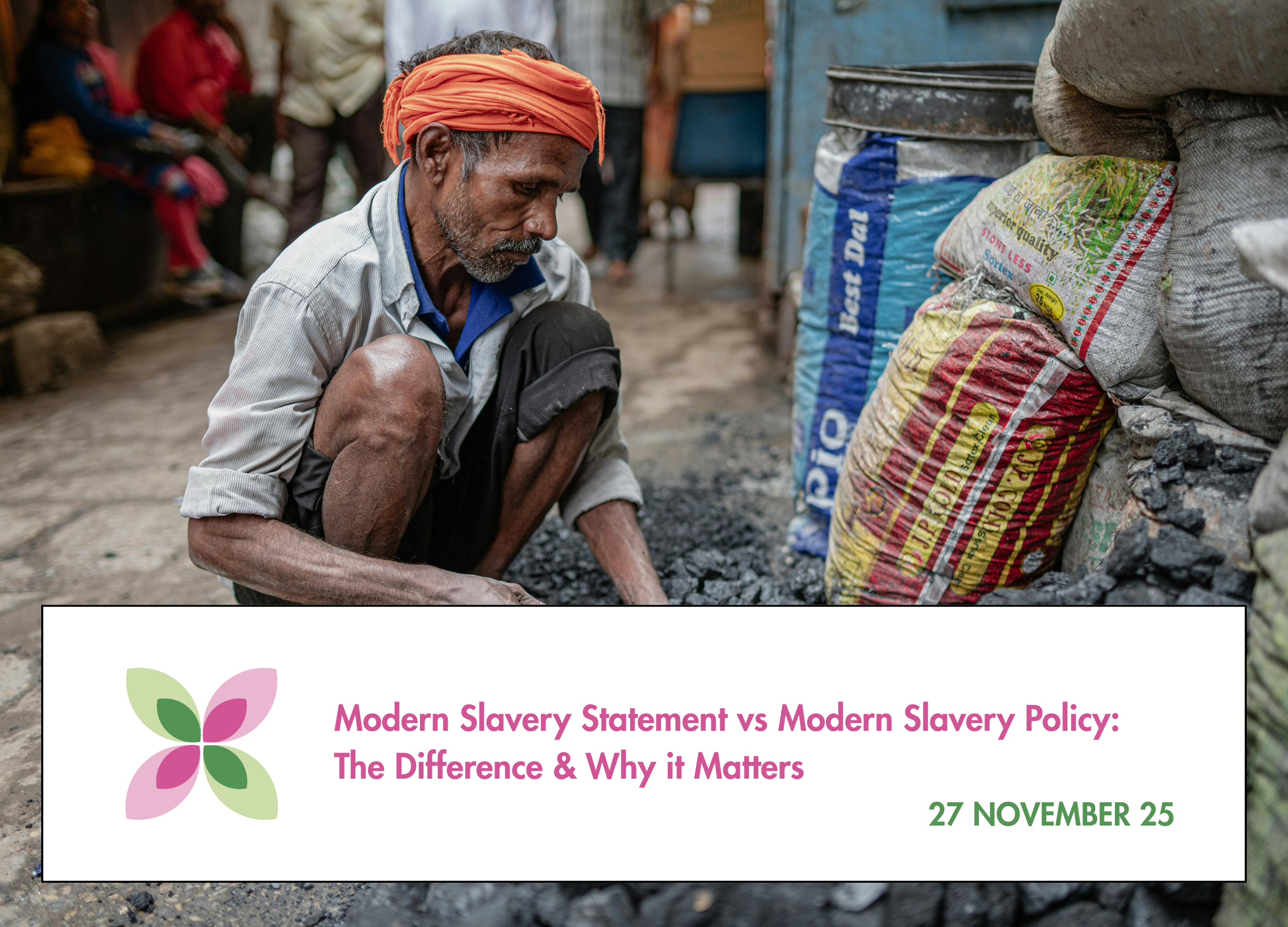
Modern Slavery Statement vs Modern Slavery Policy: The Difference & Why it Matters

If you’re an architect, designer or specifier conducting due diligence on product suppliers, you want to make sure your suppliers are taking meaningful action to address modern slavery.

This means that understanding the difference between a Modern Slavery Statement and a Modern Slavery Policy is essential.

As someone who works with product manufacturers and retailers, I frequently see questions from architects, designers, construction companies, and specifiers around modern slavery.

One of the most common questions is:

Q: Do you have a Modern Slavery Statement or a Modern Slavery Policy?

These two documents are vastly different and should not be grouped together.

Let’s explore why this distinction matters.


What Is a Modern Slavery Statement?

A Modern Slavery Statement is a public document required under legislation, such as the UK Modern Slavery Act 2015 or the Australian Modern Slavery Act 2018.

It requires companies to identify risks of modern slavery in their supply chains and outline the actions they are taking to address those risks.

In Australia, the legislation requires companies to meet seven mandatory reporting criteria.

The Seven Modern Slavery Mandatory Reporting Requirements (Australia):

  1. Identify the reporting entity – Clearly state the company submitting the statement.

  2. Structure, operations, and supply chains – Provide an overview of business operations and supply chains.

  3. Risks of modern slavery – Identify where modern slavery risks exist in your operations and supply chains.

  4. Actions taken to address risks – Outline steps taken to mitigate modern slavery risks.

  5. Assessing effectiveness – Describe how the company measures the success of its actions.

  6. Consultation process – Detail how the company consulted internally and with owned entities.

  7. Any other relevant information – Include any additional information that adds context.

While the statement must meet these mandatory requirements, not all statements are equal in quality.

Some companies publish detailed, thoughtful statements that show genuine efforts to address risks. Others, however, lack substance and appear to be more of a box-ticking exercise.


What to Watch Out For

If a company’s statement simply claims that it works with “reputable suppliers” and sees “little to no risk” of modern slavery, this is a red flag.

It suggests that they may not have conducted a thorough risk assessment of their supply chain — particularly at the Tier 2 and Tier 3 levels. These deeper tiers often carry the highest risk of modern slavery, especially in industries like textiles, electronics, and construction materials.

For specifiers conducting due diligence, it’s important to:

  • Read the statement carefully

  • Look for evidence of real action

  • Assess whether the company addresses the seven mandatory requirements

  • Check if the company outlines risk assessment processes and remediation plans

If a company’s statement looks the same year after year with no updates or improvements, this could indicate that their actions are not evolving or that they are treating this as a one-off exercise.


What Is a Modern Slavery Policy?

A Modern Slavery Policy (or, preferably, a Human Rights Policy) is an internal document that outlines a company’s commitment to addressing modern slavery and human rights risks.

A robust Human Rights Policy should:

  • Go beyond just modern slavery and address broader labour and human rights issues

  • Include freedom of association, the right to collective bargaining, non-discrimination, and safe working conditions.

Having a policy doesn’t mean a supplier is taking action

Policies are important as they set out the company's intentions and commitments.

However, a policy does not necessarily mean the company is taking action.

I’ve written many Human Rights Policies for clients to meet tender requirements or prequalification standards, but that’s where it ends. Policies often sit in a drawer, never to be actioned.

For this reason, a policy alone should not be considered sufficient evidence of a company’s efforts to address modern slavery.

Key Questions to Ask Suppliers with Policies

If you’re accepting a policy as part of your due diligence process, follow up with the supplier and ask:

  • Have you conducted a risk assessment of your supply chain?

  • Have you identified high-risk products, materials, countries, industries, and worker types?

  • What actions are you taking to address these risks?

  • How do you evaluate the effectiveness of your actions?

  • Do you have a remediation process in place?


Why the Difference Between A Statement and a Policy Matters

The distinction between a Modern Slavery Statement and a Modern Slavery Policy is crucial because it highlights whether a company is actually taking meaningful action or simply making promises on paper.

A statement should demonstrate that a company is actively working to:

  • Identify risks

  • Take action to address them

  • Measure the effectiveness of their efforts (Are we having an impact)

  • Continuously improve year-on-year

A policy, while important, is only a starting point. It should guide the company’s actions but needs to be supported by ongoing risk assessments, supplier engagement, and remediation processes.


The Problem with Box-Ticking

Unfortunately, many companies take a tick-box approach to addressing modern slavery.

They may draft a policy or publish a statement, and then believe their work is done. This approach will not reduce modern slavery or improve the conditions of vulnerable workers in supply chains.

As an industry, we need to demand more.

We need to:

  • Conduct proper due diligence

  • Engage with suppliers beyond Tier 1

  • Continuously improve our systems

  • Measure the impact of our actions

The only way to eradicate modern slavery is through meaningful action — not just compliance and box ticking.


You have the power to make a real and lasting difference

If you’re conducting due diligence on suppliers, don’t just ask for a policy or a statement. Read the documents. Assess whether the company is identifying risks, taking action, and measuring effectiveness.

Remember: A policy is a promise. A statement should be evidence of action.

The goal should be to partner with companies that are committed to making a real difference in addressing modern slavery risks in their supply chains.


Want to know more about Modern Slavery Statements?

Even if you're not legally required to report under the Modern Slavery Act (Cth), many of your clients are. And increasingly, they expect their suppliers to step up – especially those providing furniture, textiles, fittings, finishes, or design services.

This article explains what a modern slavery statement actually is, why it matters and some simple steps to help you get started.

The 7 Modern Slavery Statement Red Flags (& how to spot them)

What to look for when you’re reviewing a Modern Slavery Statement to know when a company is simply “Ticking a Box”

Modern slavery and labour exploitation are widespread, affecting supply chains in almost every industry, including the interior design industry.

Governments, consumers, and specifiers increasingly expect companies to address these issues transparently and ethically.

Yet, while some organisations are sincere in their efforts, many engage in what’s known as “box-ticking” — doing the bare minimum to appear compliant without creating real, long-term, substantial change or making meaningful plans for long-term impact. And some well-meaning companies may be box-ticking unknowingly, believing they are doing enough when they are not.

Let’s be clear: taking a tick-box approach to addressing modern slavery will not end modern slavery and will have little to no impact for the vulnerable men, women, and children in the business operations or supply chains of Australian businesses.

We all need to take meaningful action to end modern slavery.

And that means Modern Slavery Statements can’t be just for show.

But how can you tell?

Let’s look at the 7 red flags you should be looking for to tell company’s modern slavery response is meaningful or just ticking the box.

The 7 Modern Slavery Statement Red Flags

1. Superficial or Vague Modern Slavery Statements

A modern slavery statement is required by law for entities with annual revenue over $100 million, particularly in regions like the UK and Australia.

But the depth of these statements can reveal much about a company’s commitment.

Box-ticking companies may use generic, vague language that speaks broadly about “upholding values” and “commitment to human rights” without offering specifics.

A meaningful response will detail the company’s practices, including:

  • Specific actions and initiatives they’re taking

  • Concrete examples of identified risks and challenges

  • Clear goals for addressing modern slavery and labour exploitation

  • Meaningful impact metrics that go beyond compliance to measure real change

A clear sign of genuine intent is transparency around shortcomings or areas needing improvement.

Honest companies will openly discuss these issues, whereas a box-ticking company will often gloss over them.

2. Lack of Leadership Accountability

A genuine commitment to combating modern slavery often involves leadership at the highest levels.

Every CEO, board, senior management team, or managing director wants either to appear to be doing the right thing or to actually do the right thing, but they may not be willing to resource the work it takes for meaningful action.

Look for companies where senior executives or board members take an active role in setting and reviewing anti-slavery measures.

Companies that are just ticking boxes tend to delegate responsibility to lower-level staff or consultants without executive oversight or involvement.

If the senior leadership team is not fully engaged in the work, and not willing to resource initiatives and projects, then it’s unlikely that the company is committed to taking meaningful action.

3. Not Properly Identifying Modern Slavery Risks or Saying They Have No Risk

I see this quite frequently: some companies don’t clearly identify where their modern slavery risks are, or they just say they work with “ethical,” “socially responsible,” or “reputable” brands, as if that alone is enough.

When I see this, it makes me think one of two things: either they don’t actually know where their risks are because they haven’t mapped their supply chain or done a proper risk assessment, or they’re not willing to be transparent about their risks.

The reality is, if you don’t know which services, products, materials, countries, or industries are high risk, you don’t know where to focus your efforts.

I’ve also seen companies admit they buy from countries outside Australia, but then they don’t give any details about where exactly they’re sourcing from or what they’re buying. That kind of vague disclosure is a red flag.

A committed and transparent company’s response would:

  • Detail in their statement the high-risk countries, materials, products, services, industries, and worker types

  • Detail the specific types of modern slavery associated with each risk indicator (e.g., the worst forms of child labour linked to procuring timber from Vietnam).

  • Report on the analysis, data, and websites used to conduct the assessment, ideally drawing from multiple sources rather than relying on just one or two.

  • Explain how they may be contributing to or linked to modern slavery and labour exploitation through their own procurement practices.

We need to remember that the risk may not lie with their tier-one suppliers, but further down the supply chain. Curiosity and knowledge are key.

4. Lack of Regular Reporting and Measurable Impact Analysis

Effective modern slavery initiatives are ongoing and require regular review.

Companies truly committed to addressing modern slavery and labour exploitation will share measurable outcomes and updates over time, not just issue a one-time statement.

Look for:

  • Quantitative data on audits, inspections, and supplier assessments

  • Progress updates on initiatives, year over year

  • Clear impact indicators based on meaningful actions

  • Evidence of asking uncomfortable questions (internally) and demonstrating curiosity — for example, Are we really having an impact?

When we talk about impact indicators based on meaningful actions, it’s more than just measuring straightforward KPIs like the number of training sessions conducted.

If a company only releases a single report, duplicates the same report each year, or offers no measurable progress, it may be a sign they are just ticking a box.

5. Little or No Meaningful Supplier Engagement

Modern slavery is prevalent in supply chains, often across multiple tiers.

Companies serious about labour rights invest time and resources into building meaningful, collaborative relationships with their suppliers.

This includes:

  • Genuine supplier collaboration — we’re in this together

  • Supplier assessments requiring evidence to substantiate claims — not just yes-or-no responses

  • Providing feedback to suppliers, whether it’s recognising exceptional performance or documenting necessary improvements, such as workplace health and safety

  • Collaborative initiatives to educate and improve supplier practices

  • Engaging directly with workers to better understand their working conditions and identify potential risks

  • Regular audits and on-site visits to high-risk suppliers, including unannounced third-party audits

  • Supporting suppliers to rectify issues rather than immediately cutting ties, since real change often requires long-term engagement

A lack of supplier engagement, or failure to mention supplier-related action, often points to a superficial approach. You simply can’t do this work without them.

6. Minimal or No Employee Training Programs

Another key factor in a genuine anti-slavery strategy and commitment is employee education.

Companies should train their staff — particularly those in procurement and sourcing roles, or employees responsible for recruiting contractors — on what modern slavery is, how it can occur, how to identify modern slavery risks, and how to handle those risks.

Indicators of real commitment include:

  • Regular training sessions on modern slavery and labour rights led by industry experts

  • Understanding of how a company may be causing, contributing to, or linked to exploitation

  • Clear guidelines for employees on identifying and responding to risks

  • Ongoing support and resources to help employees implement anti-slavery measures in their work.

If a company doesn’t provide training, or only superficially mentions it, it’s likely they’re not fully invested in the cause.

7. Lack of Transparency — Are Companies Coming Forward When Modern Slavery Is Found?

Companies that openly acknowledge when they have found modern slavery in their supply chains, and clearly explain the actions they’ve taken to address it — are, in my view, demonstrating meaningful commitment and true courage.

Addressing and remediating situations where modern slavery is found is essential.

Companies committed to creating impact take responsibility for improving conditions for affected workers, which may include:

  • Offering support or compensation to exploited workers

  • Working with NGOs and social services to support individuals where needed

  • Providing transparent plans to address and rectify identified issues within the supply chain

  • Conducting key learnings analyses to understand why the situation occurred, whether the company contributed to it, and what can be done differently to prevent it in the future

  • Sharing progress updates on remediation efforts.

A company that sidesteps remediation or avoids discussing specific cases likely lacks true commitment.

Beyond Box-Ticking: The Path to Meaningful Change for Labour Exploitation

The difference between a tick-box approach and a genuine commitment to addressing modern slavery is in the details.

Real impact requires commitment from the board, senior management, or managing director.

It also demands transparency, measurable goals, independent oversight, and a readiness to engage deeply with suppliers and affected workers.

Companies willing to do the hard work of scrutinising their supply chains and reporting honestly are the ones most likely to make a meaningful difference — and they’re the companies you want to be working with.

These companies embody the 5 Principles of Meaningful Action: they build connection with their suppliers and affected workers, show commitment through sustained effort, demonstrate courage to confront uncomfortable truths, foster collaboration with stakeholders, and approach the issue with curiosity to keep learning and improving.

What does meaningful action look and feel like for your organisation?

I’m keen to hear your thoughts on what meaningful action looks like for you. Get in touch with me and tell me how you’re doing it.

And if you want honest feedback and ideas for meaningful action to amplify your modern slavery response, reach out to me any time here, or connect with me and join the important conversation around modern slavery and labour exploitation over on LinkedIn.