
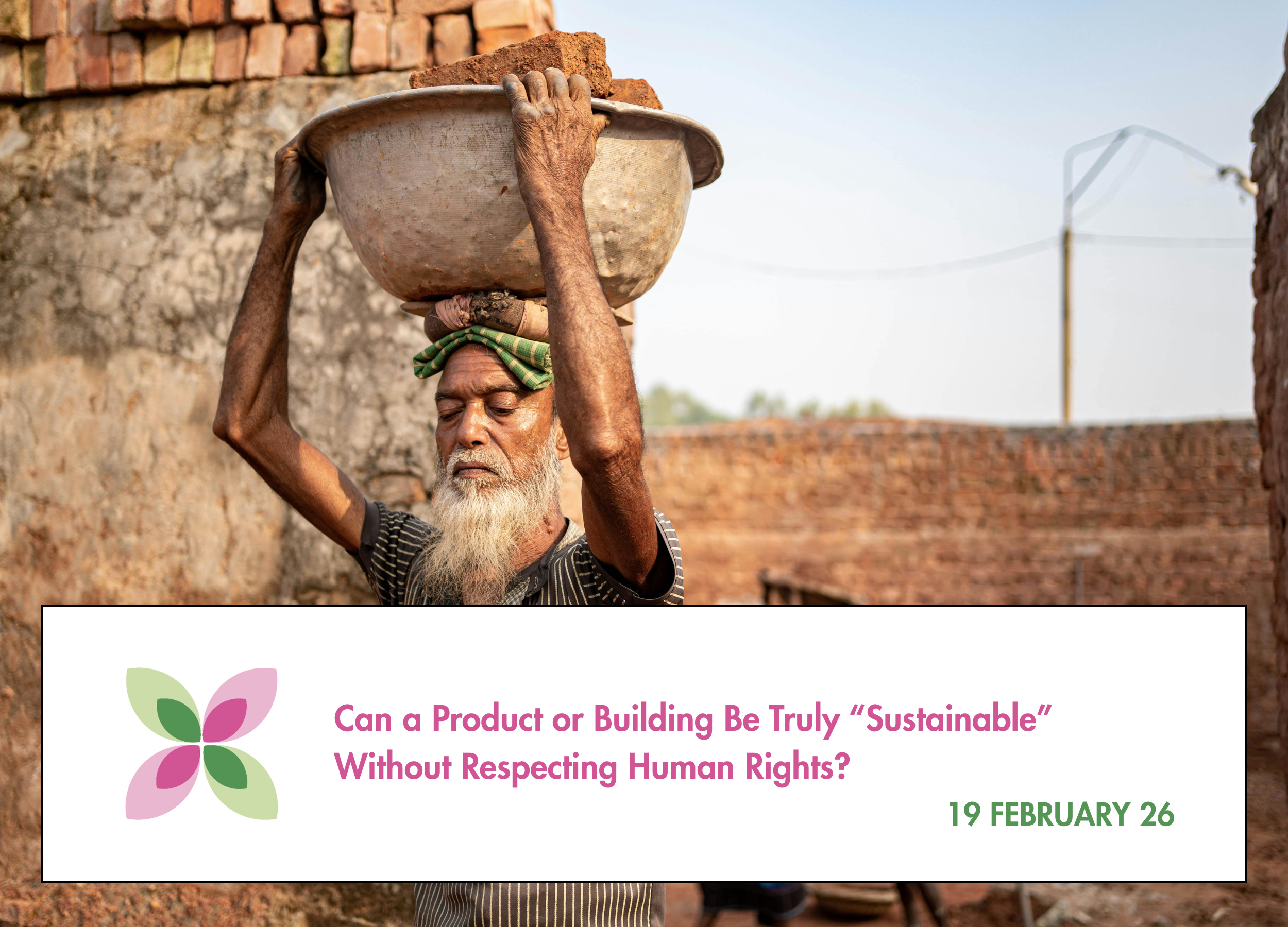
We talk a lot about sustainability in the built environment. Materials, energy efficiency, waste reduction, circular design and nature— all these matter.
But there’s one pillar of sustainability that too often gets overlooked: human rights.
The UN Sustainable Development Goals (SDGs) make this clear. Goal 8: Decent Work and Economic Growth calls on businesses to promote safe, fair, and dignified work for all.
This will be difficult to hear. But if a product or building is labelled “sustainable” yet the people who made it — or who produced the materials that went into it — are exploited, underpaid, or trapped in modern slavery, then it fails one of the most fundamental pillars of sustainability.
So, in this article, we’re going to explore an uncomfortable question.
Can we truly call something “sustainable” if human dignity is left out of the equation?
Sustainability is more than Environmental Metrics
“Sustainable” is a word that spans three dimensions: environmental, social, and governance (ESG).
Each letter represents an essential pillar of the sustainability equation –
Environmental: Carbon footprint, resource efficiency, pollution, circularity, nature.
Social: Labour rights, health and safety, equity, community impact.
Governance: Accountability, transparency, ethical procurement, and responsible business practices.
If a product ticks the environmental boxes but is produced using forced labour, unsafe working conditions, or exploitation, then the social pillar is missing and the sustainability claim becomes incomplete.
Without all three pillars, sustainability falls short and is fundamentally misaligned with SDG 8.
Human Rights are core to Social Sustainability
Global frameworks reinforce this:
The UN Guiding Principles on Business and Human Rights establish that respecting human rights is a baseline expectation for all businesses, even small businesses.
Modern slavery, forced labour, and exploitative practices are increasingly recognised as systemic social sustainability risks.
ESG standards, certification schemes, and investors now expect companies to demonstrate decent work practices alongside environmental performance.
Ignoring human rights isn’t just ethically questionable — it’s increasingly seen as incompatible with genuine sustainability.
Is sustainability built on cheap labour truly sustainable?
Sustainability isn’t just about addressing environmental issues. It’s also about how we create value and at what cost.
A product or building that is “sustainable” from an environmental perspective, but only because it relies on cheap, exploited labour isn’t a sustainable business practice — it’s a risk.
Low-cost shortcuts may reduce construction costs, but they come at the expense of human rights, long-term reputation, and supply chain resilience.
True sustainability requires fair treatment of workers, ethical sourcing, and responsible procurement — even if it comes at a slightly higher cost.
Cutting corners on human rights is never a sustainable shortcut.
What unethical sourcing is actually costing you.
Public perception matters.
Even if a company technically focuses on environmental metrics, stakeholders are watching. We know that:
Customers are more conscious than ever about ethical sourcing.
Investors are integrating social sustainability into their due diligence.
Regulators and certification bodies are tightening expectations around human rights and labour practices.
Claiming a product or building is sustainable while overlooking labour rights can quickly be seen as greenwashing — or even bluewashing when it involves misleading social and human‑rights claims — which undermines trust and credibility.
Taking a balanced, practical approach to social sustainability
This isn’t about blame or fear. It’s about alignment and action.
Here’s how you can achieve a balanced and practical approach to social sustainability:
Start by acknowledging that human rights are integral to sustainability.
Understand the risks in your business operations and supply chains, especially in high-risk materials and products.
Take practical steps to ensure ethical recruitment, fair wages, safe working conditions, and grievance mechanisms are in place not only in your direct operations but throughout all levels of your supply chain. This means understanding and addressing risks in upstream suppliers, contractors, and subcontractors where migrant workers or vulnerable labour may be engaged.
Integrate social risk into sustainability reporting, certifications, and procurement decisions.
When we take these steps, sustainability moves beyond a checklist of environmental metrics and becomes a holistic commitment to people, planet, and performance.
Bottom Line: If it’s made via the exploitation of people, then it’s not truly sustainable
Products, buildings, and projects can’t claim to be truly sustainable if workers’ rights are ignored.
Environmental innovation matters, yes — but human dignity, fair treatment, and freedom from exploitation or modern slavery are non-negotiable.
Sustainability that turns a blind eye to forced labour, debt bondage, or unsafe working conditions isn’t sustainability at all — it perpetuates harm and undermines trust in the products and projects we deliver.
It’s time for our industry to take human rights seriously, integrate protections against modern slavery and exploitation into every sustainability claim, and design a built environment that’s ethical, responsible, and truly sustainable — fully aligned with the UN SDGs, including Goal 8: Decent Work for All.
Real sustainability is about people. And now is the time to act.
Sustainability that ignores people isn’t real sustainability. It’s time to turn intention into action — to protect workers, uphold human rights, and end exploitation in every corner of our supply chains.
We have the knowledge, tools, and responsibility — now let’s lead the way and make sustainability meaningful, together.
Join the Movement
We all have a role to play. Clients, architects, designers, specifiers, and suppliers: join us in making human rights central to sustainability.
Comment below, share your experiences, or commit to one practical action this week to protect workers and create truly sustainable projects.